An invoice is far more than a simple proof of payment. It is a legally relevant document with tax and accounting implications. Whether you provide services, sell products, or work as a freelancer: your invoices must meet legal requirements and include certain mandatory details.
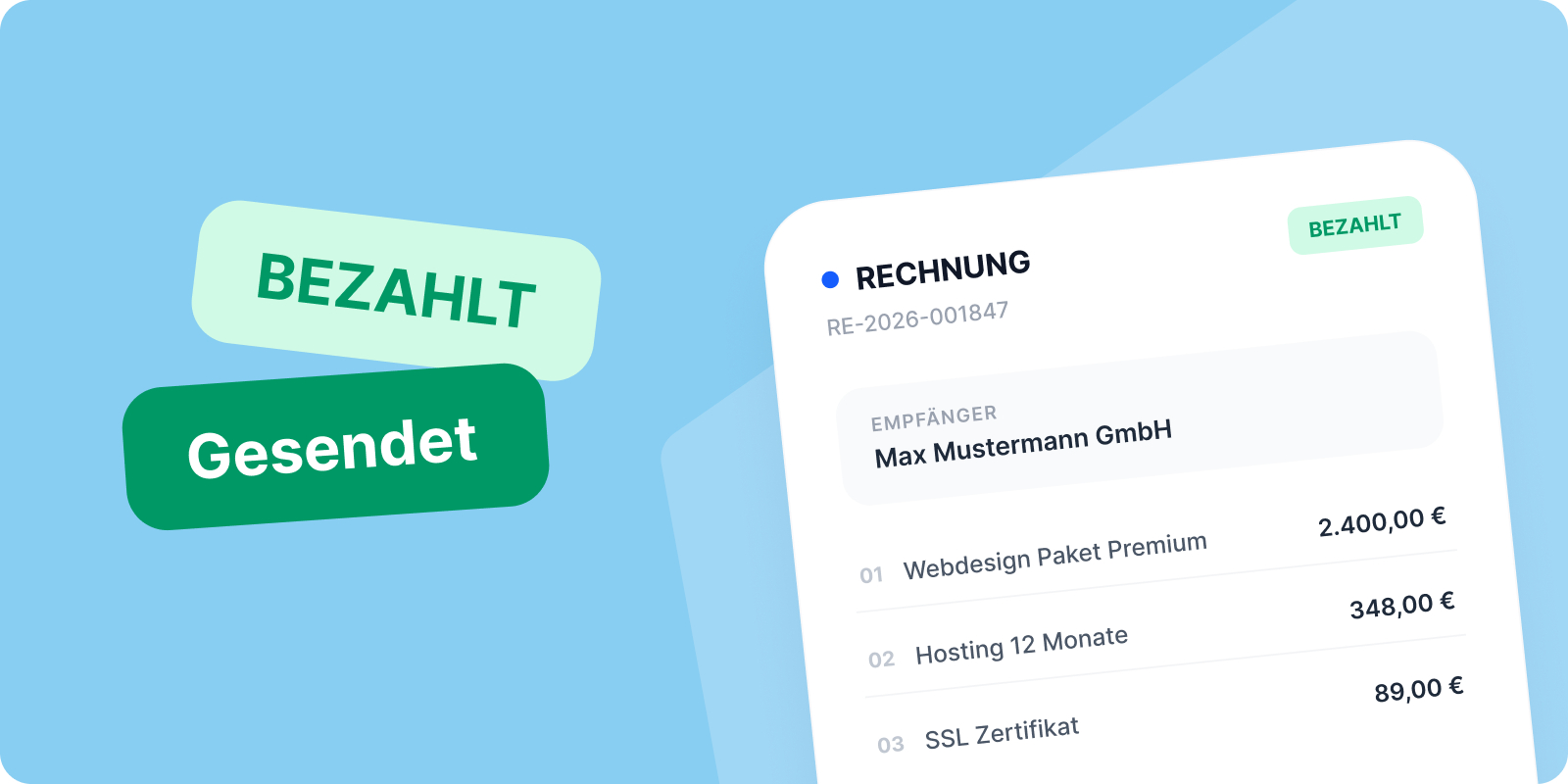
An invoice is a document with which a business bills a specific service or delivery and asserts its claim for payment against its customer. It serves as proof of a transaction for consideration and plays a central role in tax law, especially with regard to VAT.
The legal requirements for an invoice are set out in § 14 of the German VAT Act (UStG). Only if an invoice contains certain mandatory details does it entitle the recipient to input tax deduction, allowing them to reclaim the VAT paid from the tax office.
With a professional invoicing software you are automatically guided through all requirements. Mandatory details, number ranges, tax notes—everything is requested correctly and implemented in compliance with the law.
What is an invoice?
An invoice does not only document the claim for a payment. It also serves as evidence for the VAT that you owe to the tax office or can claim as input tax. For the tax office to recognize your invoices, you must provide certain information in accordance with § 14 UStG. If this information is missing, it can lead to problems with tax, payment delays, or even the repayment of input tax that has already been deducted.
Mandatory details on an invoice

According to § 14 UStG, the following mandatory details are required for invoices over 250 euros:
- Stated VAT amount
- Name and address of the issuing company
- Name and address of the customer
- Tax number or VAT identification number
- Date the invoice is issued
- Sequential, unique invoice number
- Date of delivery or service
- Description of the goods delivered or service provided
- Net amount (remuneration)
- VAT rate (e.g., 19% or 7%)
Additional mandatory details for e-invoices (EN 16931)
An e-invoice must be provided in a structured, machine-readable format (such as XRechnung or ZUGFeRD). To ensure it can be processed automatically by the recipient system, additional technical mandatory fields must be populated beyond the classic details:
- Leitweg-ID (for public authorities): For invoices to public contracting authorities (B2G), the Leitweg-ID is mandatory. It functions as a digital address and ensures that the invoice is correctly assigned within the authority’s structure.
- Buyer reference: Many companies in the B2B sector require a specific reference number (e.g., an internal project or cost center number) that must be stored in a designated data field.
- BT numbers (Business Terms): The European standard EN 16931 defines exact fields (so-called Business Terms) in which information such as the IBAN, the cash discount rate, or the email address of the contact person must be provided.
- BT codes for tax rates: Instead of free text, standardized codes must be used (e.g., “S” for the standard tax rate or “AE” for the reverse-charge procedure).
- Validity of the dataset: For tax purposes, an e-invoice is only considered proper if the XML dataset is technically error-free. A simple “typo” in the code can cause the invoice to be automatically rejected by the customer’s system.
Tip: With a professional e-invoicing program like easybill, you don’t have to worry about the mandatory details. The software validates your entries in the background, ensuring that your e-invoice is guaranteed to comply with legal and technical standards.
Additional details – useful, but not mandatory
- Customer number or project number
- Payment term and bank details
- Cash discounts or discounts
- Order or contract number
- Phone number or email for queries
This information increases the traceability and professionalism of your invoice and may be requested by your customers. You can also predefine this in easybill and have it inserted automatically.
GoBD-compliant invoice creation and retention
The GoBD (principles for the proper keeping and retention of books) stipulate that invoices:
- must be stored in an unalterable manner
- must be documented completely and without gaps
- must be readable at all times, even after 8 years (statutory retention period)
With easybill, you create GoBD-compliant invoices automatically. All invoices are archived securely, exportable for your tax advisor, and can be found again at any time.
Invoice templates will no longer be valid in the future
Invoice templates in Word or Excel were helpful for a long time. But from 2025, new requirements will apply: With the mandatory e-invoicing requirement in the B2B sector, invoices must be able to be received in a structured format such as XRechnung or ZUGFeRD, and from 2028 the e-invoice will be mandatory for everyone. Classic templates will no longer be suitable by then at the latest; they meet neither the technical nor the legal requirements. Writing an invoice is much easier with an invoicing program. It saves a lot of time and grows with the number of invoices.
Our recommendation: switch to easybill
With easybill, you create legally compliant invoices that meet all requirements of the mandatory e-invoicing requirement. The invoicing program automatically checks mandatory details, generates structured invoice formats, and archives in a GoBD-compliant manner – ideal for the self-employed, freelancers, and small businesses.
Invoice types at a glance
In practice, there are different types of invoices—depending on the business transaction:
Progress invoice
Partial payments for projects in multiple phases.
Example: a web developer bills project milestones separately.
Recurring invoice
Issued regularly for ongoing, unchanged services.
Example: monthly rent or a maintenance contract.
Recurring invoice (subscription)
For subscriptions or automatic billing cycles.
Easybill can generate these invoices automatically and on time.
Cancellation invoice / correction invoice
For correcting incorrect invoices. With just one click, Easybill creates a legally compliant cancellation invoice with the correct reference to the original number.
Small-amount invoice
For invoices up to 250 euros gross, reduced mandatory information applies. Easybill detects these cases automatically and adjusts the fields accordingly.
Credit note
Used when you grant your customer a credit or create credit notes for others yourself (e.g., for commissions).
Invoicing abroad: what you need to consider
If you issue invoices to other EU countries or to third countries, additional requirements apply:
- The customer’s VAT ID is required (for B2B within the EU)
- Note on the reverse-charge procedure:
“Tax liability of the recipient of the service pursuant to § 13b UStG” - Invoices in foreign currency or in English are possible
- Consideration of delivery thresholds (for B2C)
With easybill, you can also create multilingual invoices, state exchange rates correctly, and add automated reverse-charge notices.
Deadlines and retention of invoices
An invoice must be issued no later than six months after the service has been provided if the service is taxable and supplied to businesses (§ 14 para. 2 UStG).
According to §14b UStG business owners must retain invoices in compliance with the GoBD for eight years. The retention period was shortened in 2025 and begins at the end of the year in which the invoice is issued.
E-invoicing requirement from 2025
As of 1 January 2025, Germany will begin introducing the requirement for e-invoices in the B2B sector:
| Year | Regulation |
|---|---|
| 2025 | All companies must be able to receive e-invoices |
| 2026 | E-invoicing required for sending for companies with > 800,000 € turnover |
| 2027 | E-invoicing requirement for all companies for B2B transactions in Germany |
E-invoice means: structured, machine-readable formats such as XRechnung or ZUGFeRD; a PDF alone is no longer sufficient because it is not machine-readable. A valid e-invoice always also includes an XML file.
Easybill is prepared for both formats and already offers you the option to create, send, and archive e-invoices in compliance with the rules.
Professional invoice design – more than just a requirement
Invoices are also part of your brand presence. With easybill, you can:
- insert your logo
- choose custom colors and layouts
- create invoices in your own corporate design
This helps you make a professional impression on customers as well.
Legally compliant invoices with easybill
easybill is a cloud-based invoicing program that lets you manage your invoices professionally,
legally compliant, and time-efficiently.
- Creating e-invoices made easy: Legally compliant, fast, and without technical hurdles.
- Seamless integration with your online shop: Automatically invoice orders and save time.
- Work paperlessly with your tax advisor: All documents digital, always at hand.
Frequently asked questions about invoices
Anyone with a commercial or freelance activity and a valid tax number or VAT ID. Private individuals may only issue invoices in exceptional cases and may not show VAT.
Either your tax number or your VAT ID. For B2B services to other EU countries, the VAT ID is mandatory.
Up to three years after the service was provided. After that, the claim may become time-barred.
Create a cancellation invoice that references the original document and issue a new, correct invoice.
Unique, sequential and traceable. Combinations of numbers, letters or dates are allowed. You should avoid gaps in the numbering sequence.
Not mandatory, but recommended. Without a deadline, a payment term of 30 days automatically applies. In easybill, you can set standard payment terms.
A cancellation invoice reverses an incorrect invoice and is kept together with a new invoice. Both documents must be clearly linked in a traceable way.
For B2B within the EU, the VAT ID is required, as well as a note about the reverse-charge procedure. Different rules apply for third countries. Easybill supports multilingual and international invoices.
As a small business owner, you do not show VAT and add the note pursuant to § 19 UStG. Easybill automatically adjusts your template.
As part of the Growth Opportunities Act (Wachstumschancengesetz), the retention period for receipts was reduced in 2025 from 10 to 8 years (§ 14b paragraph 1 UStG). The period always begins at the end of the calendar year in which the invoice was issued. This applies to paper documents as well as digital documents or e-invoices. Requirement: the documents must be readable at all times and available unchanged.
Mandatory formats are XRechnung or ZUGFeRD. In addition, the authority’s Leitweg-ID is required. Easybill offers a dedicated e-invoicing solution for this.
An invoice requests payment. A receipt confirms that payment has already been made. In terms of content, receipts correspond to a small-amount invoice.
No. For invoices to private individuals, the traditional PDF or paper invoice will still be allowed after 2027. Only B2B transactions within Germany are affected.